
Africa is no longer the “uncertain frontier” it once was for Indian professionals. In 2026, with massive infrastructure investment, the East African Crude Oil Pipeline (EACOP) approaching completion, expanding mining and renewables projects, growing IT services delivery, and rapidly maturing healthcare ecosystems across the continent, opportunities for skilled Indians have never been broader or better-paid. East Africa, North Africa, West Africa, and Southern Africa each offer distinct career paths — with packages that often beat equivalent India and Middle East alternatives.
This guide is for professionals — engineers, finance, IT, healthcare, FMCG managers, project leaders — considering an Africa move in 2026. Below: where the jobs are, what industries are hiring most actively, what salaries look like, how visas work, and how to navigate the application process safely.
Why Africa Is a Strategic Career Move in 2026
The structural drivers favouring Africa careers in 2026:
- Massive infrastructure investment: Energy, transport, telecom, and urban development projects across 15+ countries
- Oil and gas expansion: EACOP, offshore Mozambique, West African deepwater fields, Algeria/Egypt LNG
- Mining boom: Critical minerals (cobalt, lithium, copper) demand has multiplied investment in DRC, Zambia, Tanzania, Botswana
- Strong Indian diaspora networks: Long-established Indian communities in Kenya, Tanzania, Uganda, Nigeria, South Africa create soft landing
- Higher savings ratios: Many Africa contracts include free accommodation, food, and transport — net savings often exceed Middle East roles
- Career acceleration: Smaller teams in emerging markets often mean faster role progression and broader functional ownership
- Tax efficiency: Many African countries have lower personal tax rates or DTAA benefits with India
Top Industries Hiring Indians in Africa (2026)
1. Oil and Gas
The largest single category. The East African Crude Oil Pipeline (EACOP) reaches completion in mid-2026, creating sustained demand for project engineers, instrumentation specialists, pipeline integrity engineers, and shutdown maintenance professionals. Major hiring companies: SBM Offshore, SAIPEM, TotalEnergies, Schlumberger, Halliburton, Tullow Oil, Sonatrach.
Active geographies: Uganda, Tanzania, Mozambique, Angola, Algeria, Egypt, Nigeria, Ghana, Senegal, Mauritania.
2. Mining and Critical Minerals
Cobalt, copper, lithium, gold, diamonds. Demand for mine engineers, metallurgists, plant operators, geologists, and project managers. Major hiring countries: DRC, Zambia, Tanzania, Botswana, South Africa, Mali, Burkina Faso.
3. IT Services and Technology
Indian IT firms (TCS, Infosys, Wipro, HCL) and African enterprises hire heavily for software development, cybersecurity, networking, and data centre operations. Major hiring countries: Kenya, South Africa, Egypt, Morocco, Nigeria, Mauritius.
4. Healthcare and Pharmaceuticals
Doctors (especially specialists), pharmacists, hospital administrators, and pharma plant managers. Indian-origin hospital chains (Apollo, Aster) and pharma majors (Sun Pharma, Cipla) operate plants and clinics across the continent. Major hiring countries: Nigeria, Kenya, Tanzania, Ghana, South Africa, Ethiopia.
5. FMCG and Retail
Indian-origin and global FMCG firms (Bidco Africa, Coca-Cola Africa, Unilever Africa, Bharti Airtel) hire managers in supply chain, brand, sales, and operations. Major hiring countries: Kenya, Nigeria, Egypt, South Africa.
6. Construction and Infrastructure
Indian construction firms (L&T, Shapoorji Pallonji, Afcons) and Chinese-led projects employ thousands of Indian engineers and project managers. Major hiring countries: Ethiopia, Kenya, Tanzania, Uganda, Nigeria, Algeria.
7. Banking and Financial Services
Standard Chartered Africa, Stanbic, Bank of Baroda Kenya/Uganda, ICICI Bank Africa, FirstRand. Hiring for relationship managers, credit officers, treasury, compliance.
8. Agriculture and Agribusiness
Indian agro-firms in Kenya, Tanzania, Uganda, Ethiopia for plantation management, agro-processing, agri-finance, irrigation engineering.
Salary Benchmarks: Africa vs India (2026)
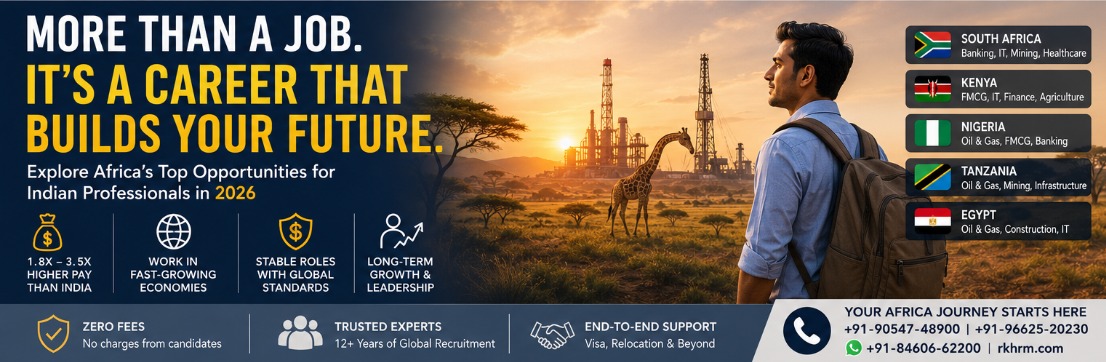
Africa salaries vary dramatically by country, industry, and contract structure. Generalising broadly, Indian professionals can expect 1.8–3.5× their Indian salary on Africa assignments, often with accommodation, food, transport, and medical fully covered.
| Role | India Salary | Africa (East/West) | Africa (S. Africa, Egypt) |
| Project Engineer (Oil & Gas) | ₹15–25 L | $45,000–$75,000 | $60,000–$90,000 |
| Mining Engineer (Senior) | ₹18–35 L | $60,000–$95,000 | $70,000–$1,10,000 |
| IT Project Manager | ₹20–40 L | $50,000–$80,000 | $60,000–$90,000 |
| Hospital Admin / Senior Doctor | ₹20–60 L | $40,000–$1,20,000 | $50,000–$1,50,000 |
| FMCG Country Manager | ₹35–80 L | $1,00,000–$2,00,000 | $1,20,000–$2,50,000 |
| Construction PM | ₹18–35 L | $50,000–$90,000 | $60,000–$1,00,000 |
| Bank Relationship Manager | ₹12–25 L | $35,000–$60,000 | $45,000–$75,000 |
| Skilled Technician (E&I) | ₹6–12 L | $1,200–$2,500/month + benefits | $1,500–$3,000/month + benefits |
Plus housing, food, transport, medical, return air tickets, and family relocation in many cases. Net savings rates often exceed 60–70% of gross.
The Best Countries to Work In Across Africa
| Country | Best For | Salary Tier | Lifestyle Score |
| South Africa | BFSI, IT, healthcare, mining engineering | High | High (developed infrastructure) |
| Kenya | FMCG, IT, finance, agriculture | Medium-High | High (large Indian community) |
| Egypt | Oil & gas, construction, IT | Medium-High | Medium-High |
| Nigeria | Oil & gas, FMCG, banking | High (with risk premium) | Medium (security considerations) |
| Tanzania | Oil & gas (EACOP), mining, agriculture | Medium-High | High |
| Uganda | Oil & gas (EACOP), construction | Medium-High | Medium-High |
| Mozambique | LNG projects, mining | High | Medium |
| Angola | Offshore oil & gas | High | Medium (Portuguese language helps) |
| Mauritius | Financial services, IT, hospitality | Medium-High | Very High |
| Morocco | Manufacturing, IT, automotive | Medium | High |
| Ghana | Oil & gas, mining, construction | Medium-High | High |
| DRC, Zambia | Mining (cobalt, copper) | High (with risk premium) | Medium |
Visa and Work Permit Pathways
Visa frameworks vary by country. The general pattern:
- Employer-sponsored work permits: Most common pathway. The hiring company applies on your behalf. Processing typically 6–12 weeks
- Skills-based migration: South Africa, Mauritius, and Botswana have skill-based programs for in-demand professions
- Project-specific work visas: For oil & gas and infrastructure projects, contractors often arrange visas as part of the contract
- Investor / business visas: Available in most countries for those starting businesses
Important: never accept a job that requires you to pay agent fees or visa fees upfront. Reputable employers and recruiters handle visas at no cost to the candidate. Always verify employer authenticity through official channels and trusted recruitment partners like RKHRM’s international recruitment practice.

The Application Process: How to Land an Africa Role
Step 1: Define Your Target Geography and Industry
Africa is too large to apply broadly. Pick 2–3 countries and 1–2 industries based on your skills.
Step 2: Engage Specialist International Recruiters
Most senior Africa roles are filled through specialist recruitment firms with international networks. Specialist agencies like RKHRM maintain relationships with operators across the continent.
Step 3: Polish Your Profile for International Search
- Update LinkedIn and CV — quantified achievements, international project exposure
- Highlight any prior Africa, Middle East, or international experience
- List relevant certifications (PMP, NEBOSH, IOSH, ISO, country-specific licences)
Step 4: Apply Selectively
Avoid spray-and-pray applications. Target specific employers and roles. Quality applications convert at 5–8x the rate of mass applications.
Step 5: Interview With Cultural Sensitivity
Africa interviews often emphasise stability, commitment, and cultural adaptability. Demonstrate willingness to commit to a 24–36 month contract and openness to local context.
Step 6: Validate the Offer Before Accepting
- Verify employer credentials independently
- Confirm visa, accommodation, medical, and repatriation terms in writing
- Cross-check salary structure against country tax framework
- Speak with at least 1–2 current/former Indian employees if possible
Practical Tips for Indian Professionals Considering Africa
- Research the country, not just the role: Lifestyle, security, healthcare, schools matter as much as salary
- Check the climate of operations: Some countries have political stability concerns; others are very safe
- Banking and remittance: Some countries have currency controls; clarify how you’ll repatriate savings
- Family decision: If your family will relocate, evaluate schools, healthcare, and community presence
- Leverage Indian networks: Most major African capitals have established Indian associations and chambers
- Tax planning: Understand how India’s DTAA with the host country affects your global tax position
- Repatriation plan: Have a clear 3–5 year plan; avoid open-ended commitments
Beware of Africa Job Scams
Unfortunately, Africa job scams targeting Indian professionals exist. Signs of a scam:
- Asks for upfront fees for visa processing, training, or “registration”
- Offers far above market rates with vague job descriptions
- No verifiable company website or office address
- Pressures quick decisions or signing without contract review
- Communication only via WhatsApp/email; no formal HR process
- Asks for personal documents before a clear offer
The safest pathway is via licensed international recruitment agencies. RKHRM has been a member of the Executive Recruiters Association (ERA) since 2012 and follows formal international recruitment protocols.
Frequently Asked Questions
Q1. Is it safe to work in Africa as an Indian?
Most African countries are safe for Indian professionals, especially those with established Indian communities (Kenya, Tanzania, Uganda, South Africa, Mauritius). Some countries require more security awareness (Nigeria, parts of West Africa). Research country-specific safety before accepting any role.
Q2. How much can I save on an Africa contract?
With covered accommodation, food, and transport, savings rates of 60–70% of gross salary are common. A $60,000 contract can mean $35,000–$42,000 saved annually — far more than equivalent India roles.
Q3. Can I take my family with me to Africa?
Most senior roles allow family relocation; junior project roles often don’t. Country choice matters — South Africa, Kenya, Mauritius, and Egypt are family-friendly. Some oil/mining sites are work-only.
Q4. Do I need to know French or Portuguese for some African countries?
For French-speaking (Senegal, Algeria, Morocco, parts of West Africa) and Portuguese-speaking (Angola, Mozambique) markets, basic working knowledge significantly helps. English alone works for South Africa, East Africa, Nigeria, Ghana.
Q5. How do I verify a job offer is genuine?
Cross-check the employer through their official website, LinkedIn, and verifiable corporate registration. Use a licensed recruitment agency. Never pay any fees upfront. Speak with current/former employees if possible.
Exploring an Africa Career Move?
RKHRM’s international recruitment practice has placed candidates across East, West, North, and Southern Africa for oil & gas, mining, IT, healthcare, and FMCG roles. Connect with us for a confidential conversation about your career options.
For Job Seekers: +91-90547-48900, +91-96625-20230
WhatsApp: +91-84606-62200
Office: Titanium City Center, 100 Feet Anand Nagar Road, Satellite, Ahmedabad — 380015
Visit: rkhrm.com/services/international-recruitment